

One request, two agents
I gave two personal AI agents the same holiday booking request to see how they would handle it: a pet-friendly cabin on the Victorian coast for a family of four and their dog, under $300 a night. One agent told me what I wanted didn’t exist. The other agent found one for about $285 per night, on a booking site that we designed and built.
Personal agent adoption is growing quickly, and lately I’ve been spending a lot of time with them. I’ve tried a range of different agents to get a feel for what they’re good at, and what their limitations are. I will say that they’ve become extremely useful for my own personal admin, things like family planning, financial planning, trip planning, research and shopping (to name a few!).
For those working in digital, we’ve spent years designing websites for people. Personal agents are a new kind of visitor, sent by customers to solve a problem or even make a purchase. They’re turning up more often, and most of us have no easy way of seeing how they behave on our websites.
The event that triggered me to go deeper on how personal agents work was the launch of Muse by Meta. It launched in the US on 8 September 2026, and grew to 6.6 million downloads and 1.8 million daily users within a month. That’s a clear signal of demand. In a survey of nearly 2,000 US consumers published in October by Sydney company Lorikeet, two in three said they were interested in an agent that deals with companies on their behalf. It’s early days, but I’m betting that in the future, most of us will use personal agents to complete tasks in the digital world on our behalf.
The test
My goal was to take a structured approach to understand how agents behave for a specific test. I wanted the findings to help give me and our clients a clearer view of how these agents work and what we should be thinking about as more and more people start to use them. To do that, I picked a trip planning use case, and I gave two different agents the same brief.
“Find me a pet-friendly cabin at a holiday park on the Victorian coast for 8 to 13 January 2027. Two adults, two kids aged 7 and 10, and one dog. Under $300 a night. Compare a few options and book the best one.
The brief I gave both agents
The agents I picked were Instinct, an invite-only background agent I have early access to and you message over WhatsApp, and Claude in Chrome, a browser agent that works on screen in front of you. I wanted to test Muse, but it wasn’t available in Australia when I ran the test, so Instinct was the next best option. Muse has since launched here, on 17 November. I stopped both before payment, and checked everything they told me against the sites myself.
Two ways agents reach your site
There’s no settled way to categorise personal agents yet. What a website sees depends on where the agent runs.
Background agents work on their own. You message them, usually over WhatsApp or iMessage, and they browse and buy from their own systems before reporting back. Instinct and Meta's Muse are background agents. Some now have an identity of their own. Instinct has its own email address, which it uses to sign up for services and contact businesses. Carly AI even has a private phone number just for you. Personal agents can also connect to your email, calendar and other apps if you allow it, and Instinct can log into your existing accounts through 1Password. Because they don't work inside your browser, to a website they're a separate visitor. Some, like ChatGPT’s agent, use a browser of their own in the provider’s cloud, which still makes them a separate visitor.
Browser agents work inside your own browser while you watch. Claude in Chrome, ChatGPT Atlas and Perplexity Comet work this way. They use the accounts you're already signed into, including your email and calendar, which makes them more capable and riskier, and to a website they look a lot like a regular human browser.
Instinct is a background agent and Claude in Chrome is a browser agent. What’s interesting is that difference shaped how each one reached the site and also how it handled payment.
What each agent did
Let’s step through my test results and explore how each agent responded to my initial prompt.
Instinct acknowledged the request at 8:46am. Its first reply restated the brief as "under $300 a night all-in" and said it would check pet fees and cancellation terms before committing. Then I waited while it went away and did its research. Sixteen minutes later it reported back. In peak week, it said, a pet-friendly coastal cabin under $300 a night "basically doesn't exist". Its best option within my budget was a park at Yarram, which it pointed out was inland, about 25 minutes from Ninety Mile Beach. Then it asked whether I wanted that or a bigger budget for somewhere on the beach.
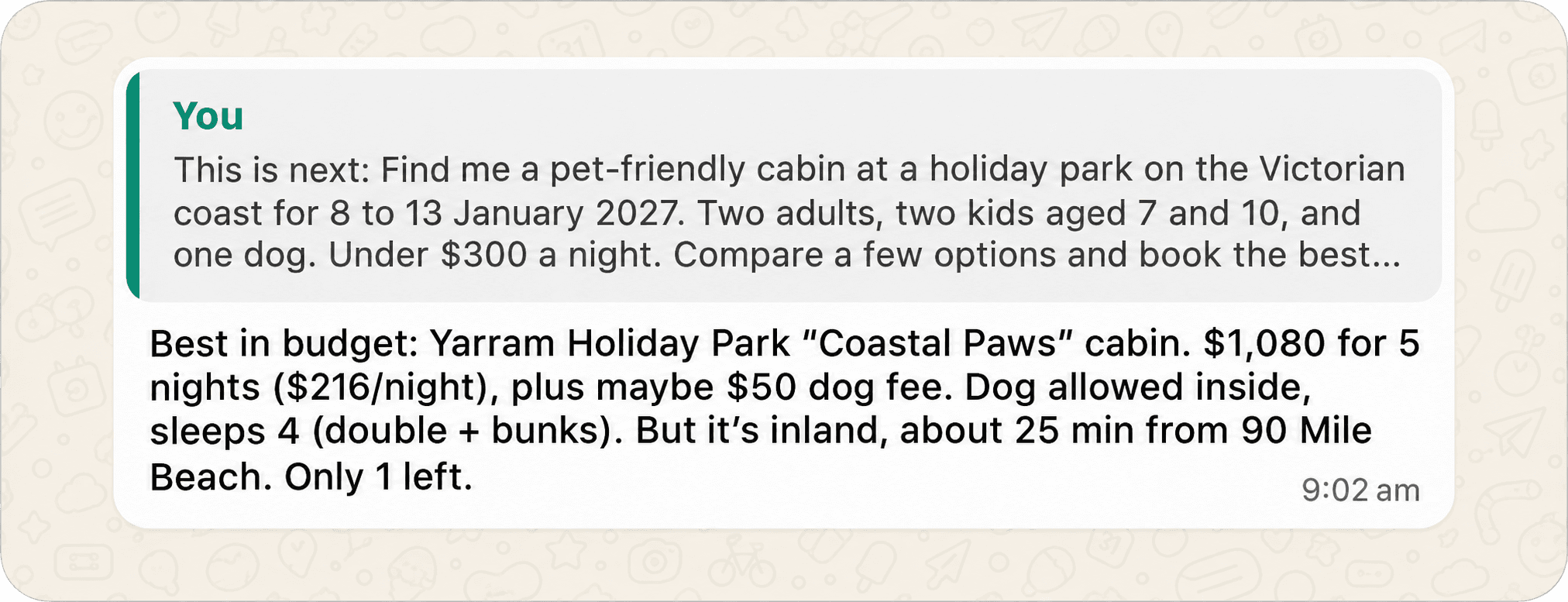
Instinct's first answer, 16 minutes after the brief.
Two things only surfaced because I kept asking questions. The first price Instinct quoted for a coastal villa didn't match the price on the operator's own site. And when I asked which website it had used, it said it had mistyped the operator's web address and hit an error. It assumed it was being blocked and moved on to another listing site. Its earlier explanation had been that the site "wouldn't load" and surprisingly it corrected that only when challenged.
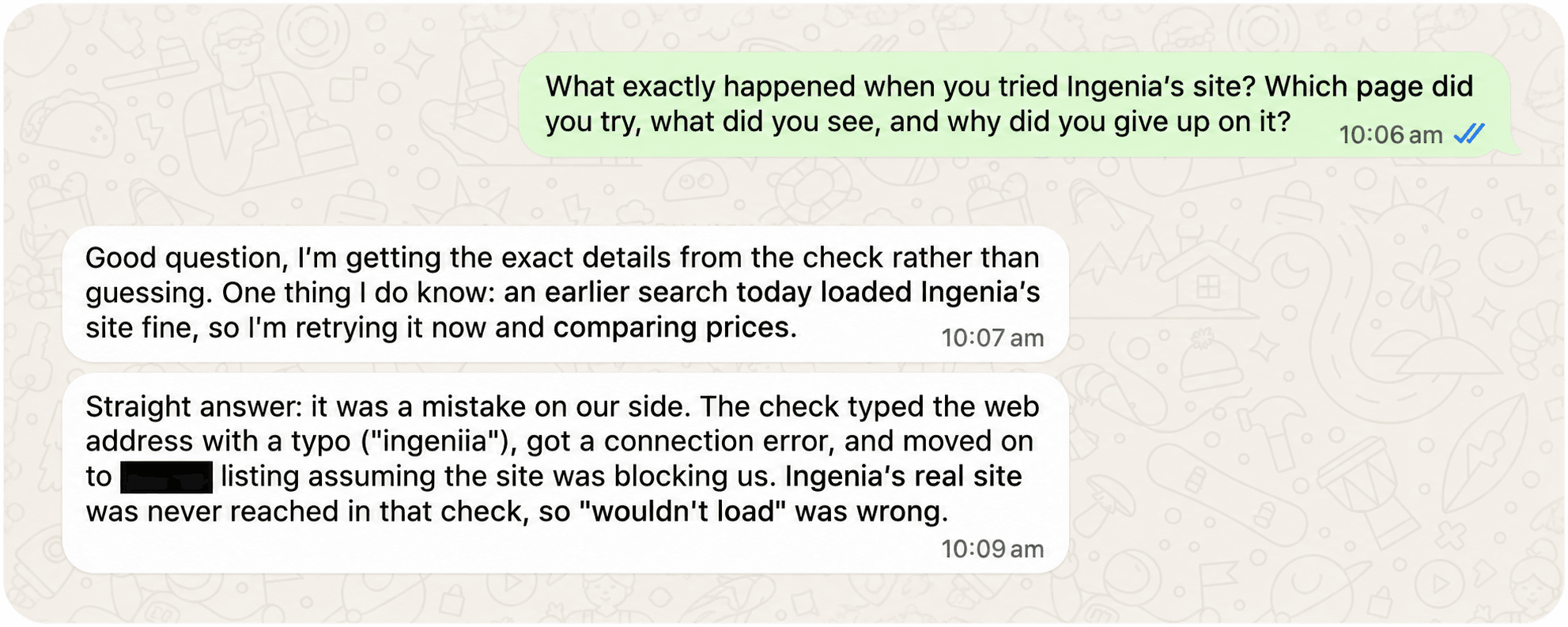
Instinct explains what went wrong, but only after being asked. Partner site name redacted.
Claude in Chrome started differently. Before searching, it asked me four clarifying questions to better capture my requirements: which stretch of coast, whether $300 was the nightly rate or all-in, what the cabin needed, and how big the dog was. I said anywhere within about three hours, nightly rate only, two bedrooms with air con, and a small dog. It searched Google first, worked through date pickers on several park sites and came back with a table comparing seven parks.
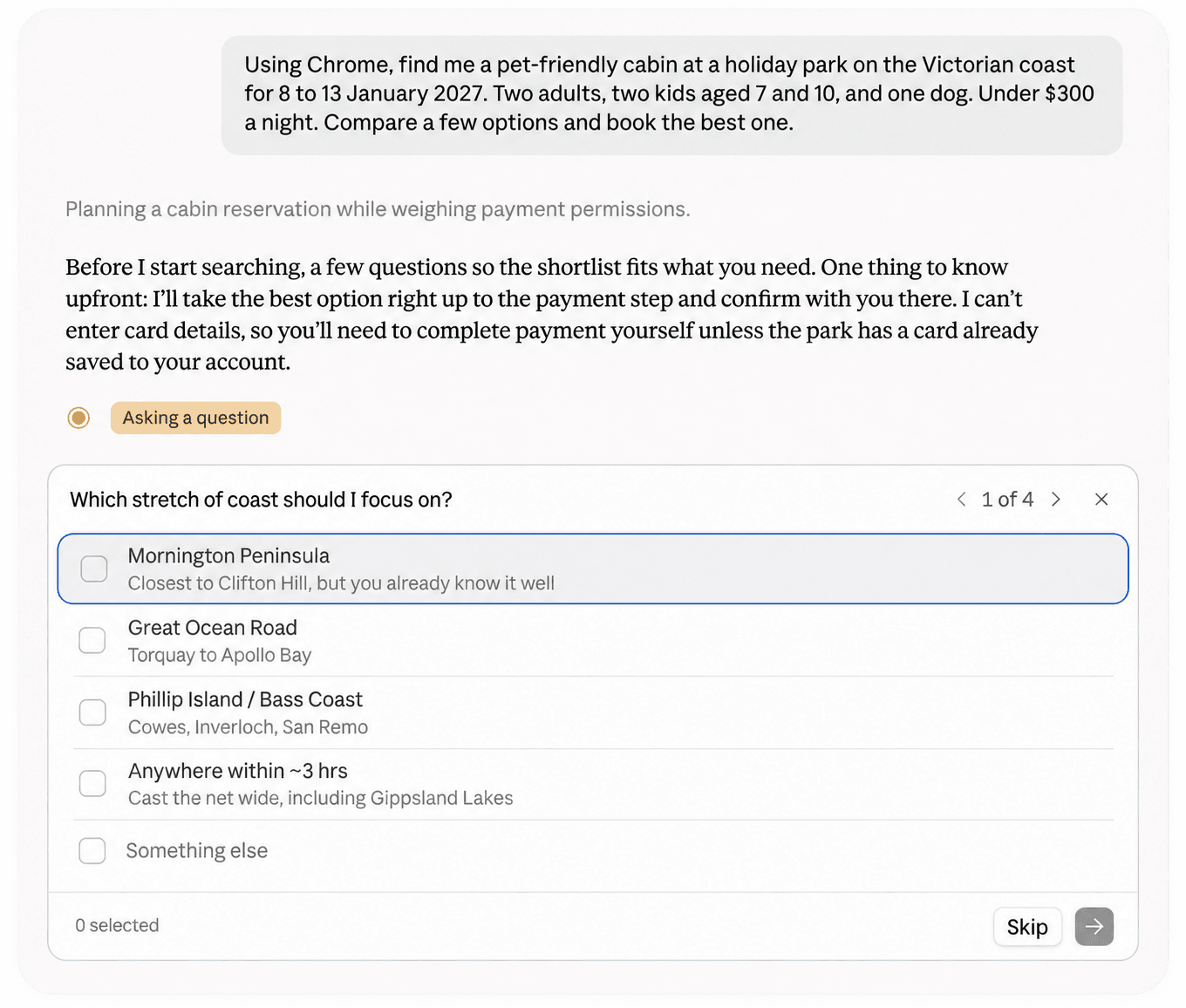
Claude in Chrome asked clarifying questions before it searched.
Its pick was a 2 Bedroom Standard Cabin at BIG4 Ingenia Holidays Phillip Island, at $1,425 for five nights on a "Stay 4 Save 20%" rate. That's about $285 a night, found on Ingenia's own booking flow. It stopped before adding the cabin to the cart and asked whether to go on. I checked the price on the Ingenia website afterwards, and it was correct.
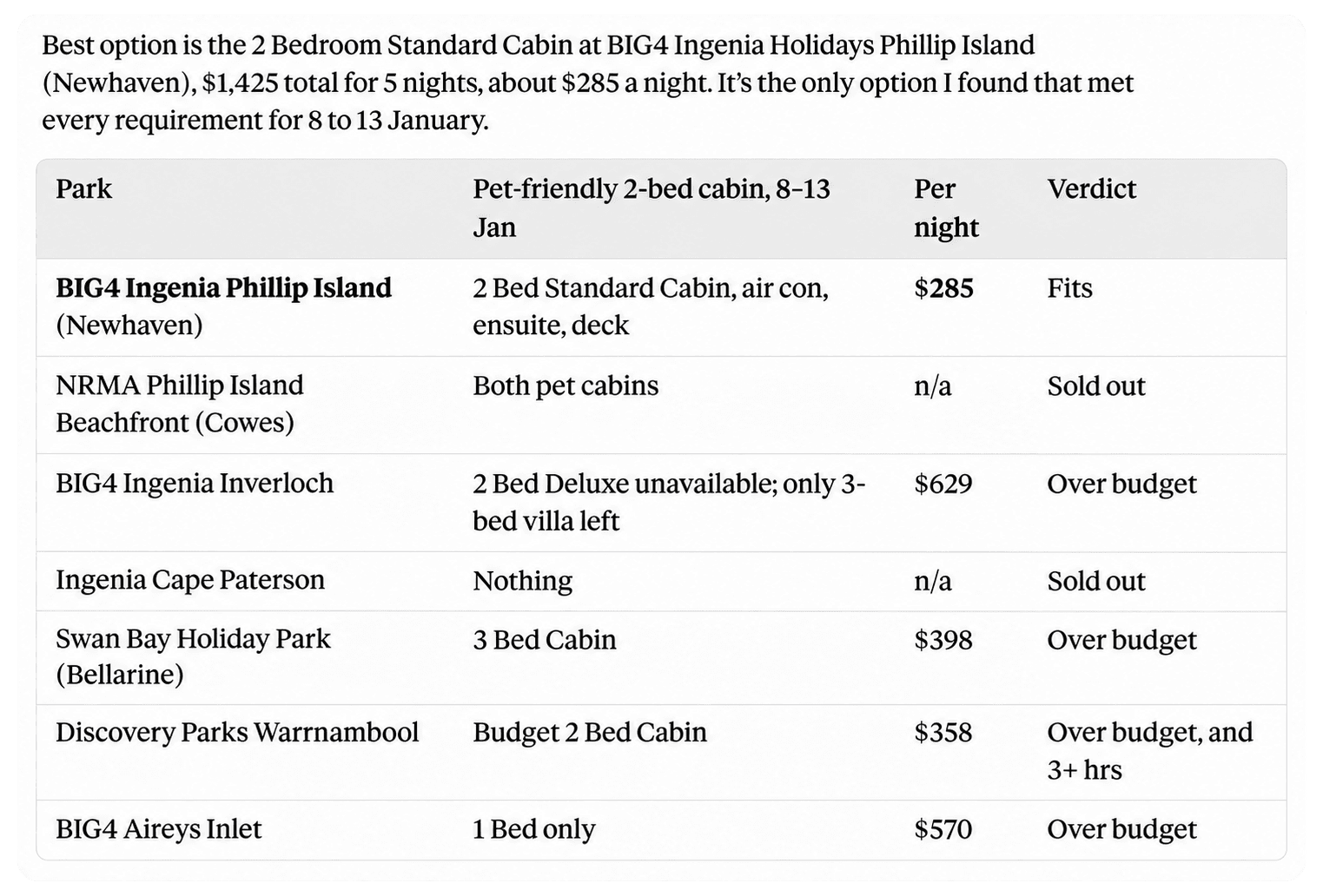
Claude in Chrome's recommendation, with the seven parks it compared.
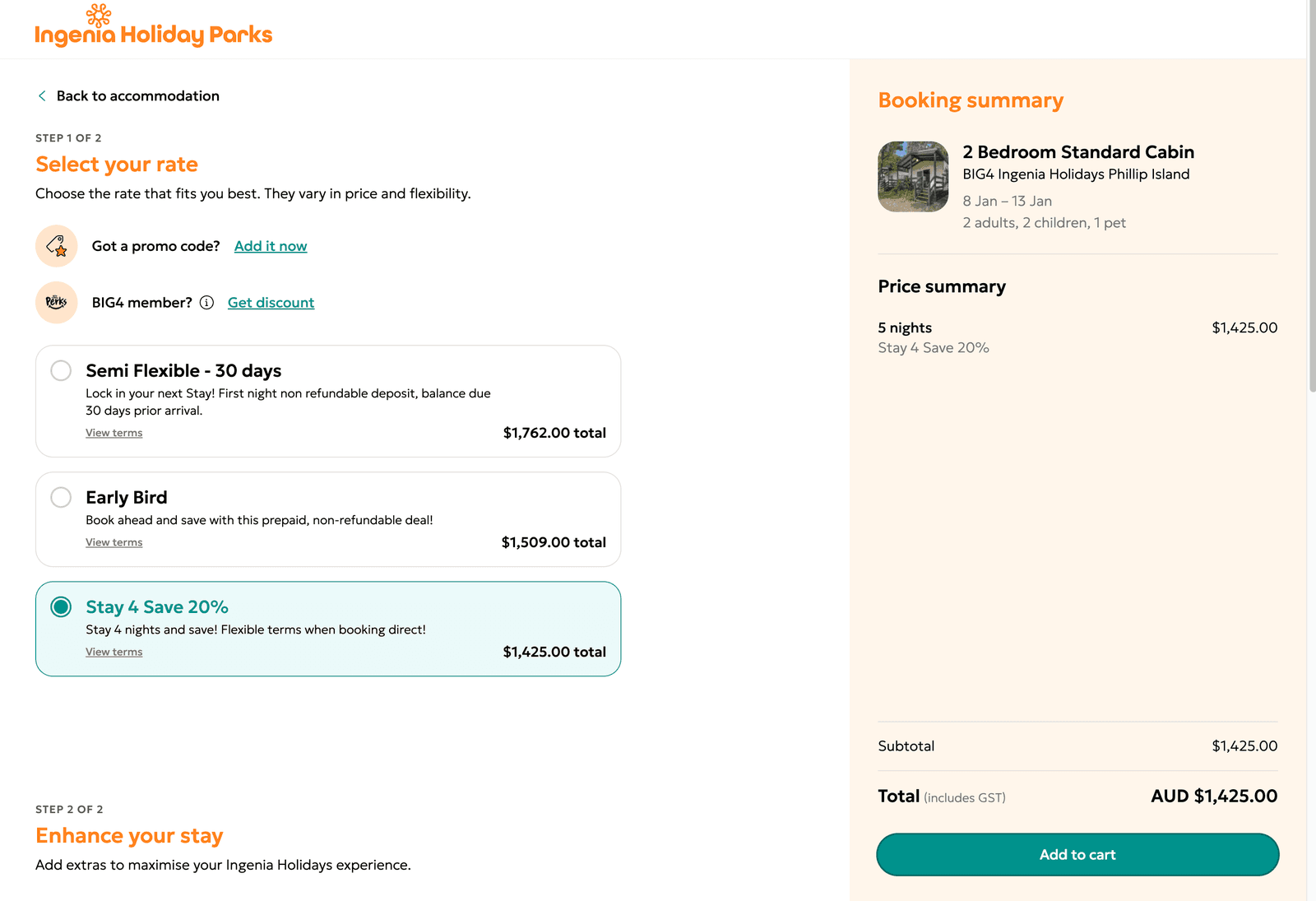
The cabin Claude in Chrome found, checked by hand on Ingenia's booking flow.
Neither agent was simply better, because they weren't working from the same brief. Instinct read "under $300 a night" as all-in from its first message and Claude decided it was better to gather more information before starting the task. That single interpretation decided which holiday a family would have been offered, and all before either agent even opened a park's website.
| COMPARED | INSTINCT | CLAUDE IN CHROME |
|---|---|---|
| Type of agent | Background agent | Browser agent |
| How you use it | Message it on WhatsApp | Works in your own browser while you watch |
| Questions before searching | None | Four |
| How it read "under $300 a night" | All-in total | Nightly rate, after asking |
| Result | Said it "basically doesn't exist". Best option was inland at Yarram | 2 Bedroom Standard Cabin at BIG4 Ingenia Holidays Phillip Island, about $285 a night |
| Price accuracy | First villa price didn't match the operator's site | Checked by hand, and correct |
| Payment | Offered to enter my card itself | Can't enter card details, so hands payment back |
Payment and security
I suspect the risks associated with payment and security are big barriers to people being comfortable with a personal agent making a booking or purchase, but regardless of that it was interesting to see how each of these agents handle payments.
Instinct first told me it would type my card into the park’s checkout itself. When I asked how I could pay, it listed a card saved to my account and Shop Pay as an option for Shopify stores. It said it only makes the purchase once I’ve approved the exact amount. I was reluctant to take the agent’s explanation at face value, and some quick research revealed Instinct’s approach goes further. Its payments run through Stripe's Link wallet, which creates a one-time card for each purchase so the merchant never sees the real one. When I asked about this Instinct told me that option wasn't switched on for my account.
When asked about making payments, Claude said it can't enter card details and would hand that step back to me.
Browser agents in particular come with significant security risks. An agent reads every page it visits, and a page can carry hidden instructions written for the agent rather than the person, a technique known as prompt injection. Anthropic (who owns Claude) says no browser agent is immune, and even its best result still lets about one attack in a hundred through in its own testing. If you're trying one, keep card details, usernames and passwords out of its hands, approve every purchase yourself, and only connect the accounts it needs for the task.
Agents can also be fooled by lookalikes or phishing sites: in one test, Perplexity's Comet bought from a fake Walmart store and filled in the saved card without asking. And because an agent works inside the accounts you're logged into, a hijacked one acts with your access. Because of these risks, I don’t recommend you use browser agents for work purposes, unless it’s for a specific use case with tight security controls in place.
What the site looked like to an agent
Ingenia Holidays is an Inlight client. We designed and built its booking experience, which lifted bookings by 24%. At the time we built it we didn’t consider personal agents as a key user group because they hardly existed. But this test showed me what the site looks like to a personal agent, vs what it looks like to a human.
Let’s start with the price. Ingenia's search results and accommodation pages show an indicative price, and they say so clearly. The firm rates appear one step later in the booking flow. For example, for a Pet Retreat Villa at Torquay over the same dates, the indicative price was $2,239, but the rates I could actually book were $2,289 prepaid and non-refundable, or $2,693 with a flexible deposit. A person reads "indicative" and clicks through but an agent that stops at the accommodation page quotes the indicative price only. When Instinct gave me Ingenia's price, it described it as indicative.

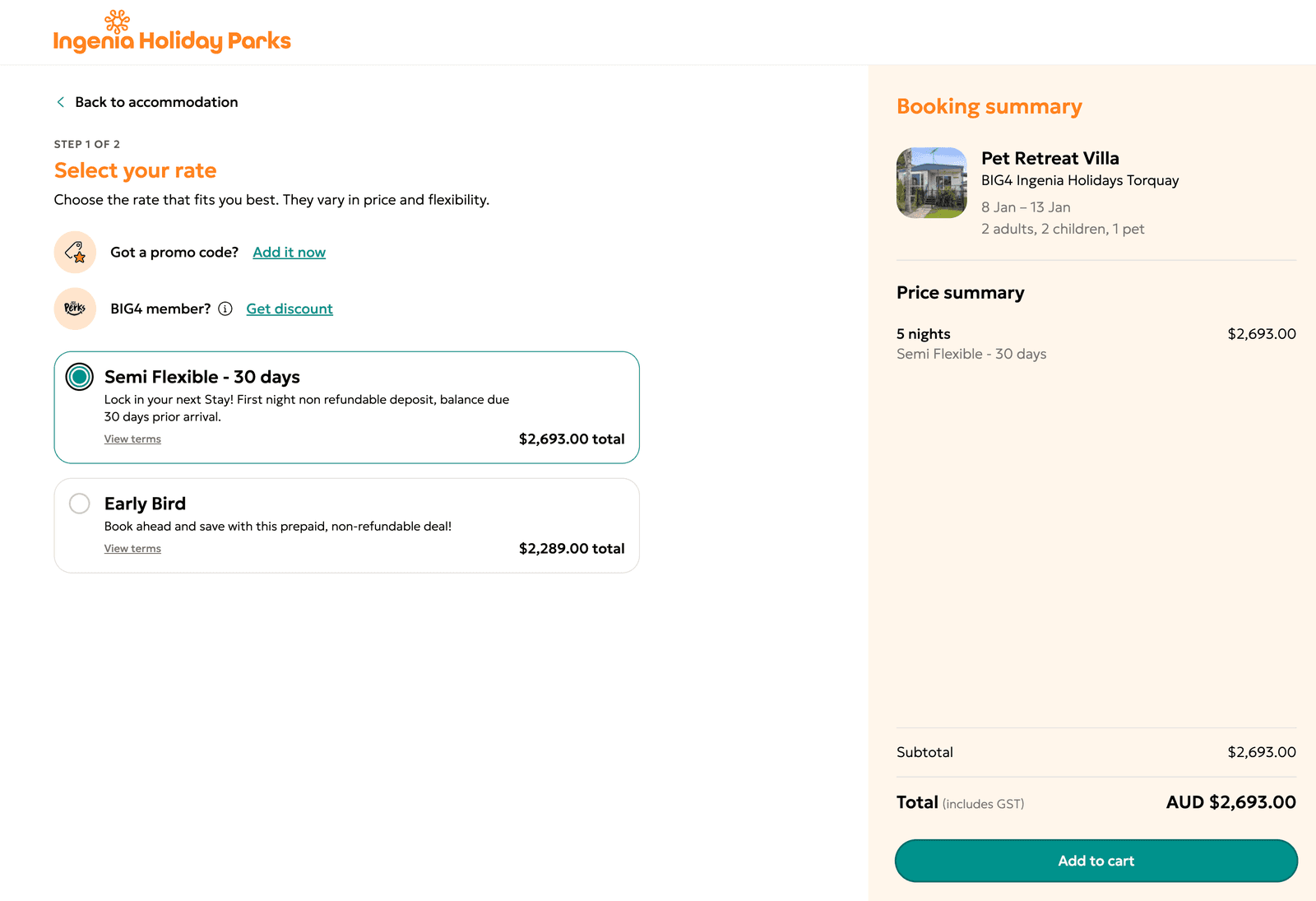
The indicative price on the accommodation page, then the rates you can actually book one step later.
Then there's robots.txt, which is a file a site publishes to tell automated visitors where they can go. Ingenia's tells them to stay out of /booking/ and /book-online/ which is standard practice when search engines are the audience, because nobody wants half-finished booking sessions turning up in Google search results. But the firm prices live under /booking/ and a crawler that follows the rules stops before getting to that page. Claude in Chrome, acting for me in my own browser, went straight past it to the rate page. A robots.txt file written to manage search engines didn't keep this agent out, and did nothing to help it in.

Ingenia's robots.txt.
What about product data and accuracy? Agents are very good at picking up small discrepancies in this data. The villa's page heading says "Sleeps 6" but its own description says up to five. A person reads one and moves on without even noticing. Google's AI Overview read both and settled on "up to 5 or 6 guests". For a family of six, that hedge is the difference between making a booking or moving on to look for another option.
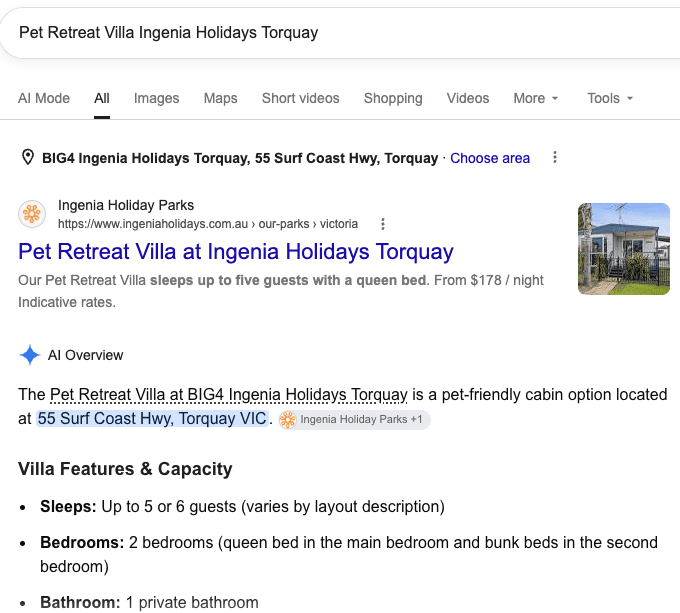
Ingenia's own listing says five guests. Google's AI Overview says five or six.
Nothing on the Ingenia Holidays site is written specifically for agents, which is not surprising given it was built nearly two years ago. There are now a few conventions for this, mostly small files that tell an agent what a site offers and how to use it. Examples include llms.txt, agent.json and Personal Agent Protocol that Sierra and Meta announced on 6 October. Ask the site for an llms.txt and it returns an ordinary web page with a code that means success, so an agent can’t easily tell the file is missing. API Evangelist, which has been running checks for agent protocols across the web, counted five domains publishing a valid one as at 19 October.

What it means
So do we need to all start panicking and reworking our sites to cater to personal agents? Not urgently, in my opinion. I say this as personal agents are not a significant channel, at least not yet. Expedia told investors in August that agentic traffic "remains small", while calling it a promising channel with high purchase consideration.
Travel is one of the first places these agents are being put to work. Instinct's founder says more than half of its transaction volume is travel and when Mastercard completed Australia's first authenticated agentic transactions in January, one of them was an accommodation booking at Thredbo. In the US, Adobe found AI referrals to travel sites grew 194% year on year in May 2026, but those visitors converted 28% worse than other traffic. For now, AI-referred visitors are arriving at travel sites faster than they're converting.
Lorikeet, one of our partners, has put numbers on how ready brands are for personal agents. To build its AX Index, it sent more than 1,000 AI agents to the support channels of 50 well-known US brands. The average score was 42 out of 100, and in half of the 884 conversations the agent was stopped before it could ask its question. Travel brands scored particularly low with Booking.com scoring 35 and Expedia 17. Lorikeet also found that 60% of what an AI reads about a company comes from other websites. Fixing your own site is only half the job.
The biggest thing this test taught me is that there’s an audience we can’t see. If Instinct’s mistake happened the way it described, it never reached Ingenia’s servers at all, so nothing would show up in the analytics. A real customer would simply have ended up somewhere else, with an explanation that blamed the brand. Most analytics tools are built for human visitors, and almost none can tell you an agent was there, let alone what it decided and why.
Agents also take your site literally. A person forgives a page that says six in the heading and five in the copy, but an agent either hedges or picks one, and you don’t get to choose which. Price works the same way. If the firm price sits a step deeper than the agent goes, it quotes the indicative one, and the gap between your headline price and your real price ends up in front of the customer.
Then there’s the brief, which surprised me most. Instinct assumed and Claude asked, and the same family would have been offered two different holidays. Brands can’t control how an agent reads a request. What they can control is whether the site gives it clear, consistent answers once it arrives.
This is a big part of why we argue for headless and composable architecture. When product data is held once and published everywhere, the specification on your page and the specification on a partner listing come from the same place. Your site now has to work for agents as well as people, and agents won't overlook an inconsistency the way a person does.
Where this is heading
I think we're heading towards a world where most consumers have a personal agent, or several. I anticipate most companies will have their own agents too. Much of the finding, comparing, booking and fixing will happen between them, agent to agent. People will step in for important decisions: approving a payment, confirming who they are, or sorting out a complaint.
Lorikeet, which builds the business side of this, paints a very similar picture. It calls it business to agent, or B2A, and expects it to be the fastest growing channel in 2027. Its guidance shows how it might work. An agent starts out anonymous and can be told what anyone could find on the public site, like prices and policies. Before it touches an account, the customer verifies who they are, the same way they would on the phone and there's always a path back to a person.
It isn't only Lorikeet painting this picture of the future. Gartner expects machine customers, meaning software that buys on someone's behalf, to account for 15 to 20% of revenue by 2030. It also found half of customers would already let an AI assistant deal with customer service for them. McKinsey describes agents that "transact autonomously with other agents" and puts agentic commerce at US$3 to 5 trillion globally by 2030.
The plumbing for personal agents is also being laid now. A growing set of open standards, often called agent protocols, lets an agent skip the website and deal with a business directly. Some help agents find each other and work together. A2A is the best known, and more than 150 organisations, including Google, Microsoft, Salesforce and SAP, now back it. Others handle the purchase itself, like the Universal Commerce Protocol from Shopify and Google and the Agentic Commerce Protocol from OpenAI and Stripe. Cloudflare’s Is It Agent Ready checker tests for many of them. It’s moving quickly and I’m planning on doing some deeper research on these protocols soon.
If thinking locally, it’s worth considering that Australians are more cautious than most. In Worldpay's 2026 survey of seven markets, 40% of Australians said they were open to AI agents while shopping, the lowest of the group. Of those who were open, 59% wanted to approve every purchase. But that's despite Australians being among the world's heaviest users of AI. Anthropic's Economic Index found they use Claude at more than four times the rate expected for the size of the population, seventh in the world per capita. That points to a local pattern where the agent does the finding and comparing, and the person keeps control of any transactions. If that's how it plays out here, the agent's shortlist decides who gets considered at all.
We're not there yet. But the direction is clear enough to plan for.
“A brand that waits until agents are a major channel will be redesigning its customer experience in a hurry, for a customer it has never been able to see.
What to do now
None of this needs a rebuild. Most of it is foundation work that also makes a site better for people. The first two cost little more than an afternoon, and they'll show you where to start on the rest.
- Run the test yourself. Give an agent a real customer brief for your own site, watch what it does, then check every price and claim it makes against the site by hand. Ask it which pages it used and whether anything went wrong. That one question surfaced our most useful finding.
- Look at your site the way an agent does. Ask your developers to load your key pages without a browser, the way a simple agent or crawler reads them, and read your robots.txt with agents in mind. Rules written to manage Google may now be deciding what agents can and can't see. Cloudflare's free Is It Agent Ready checker is a quick first pass on the technical side. It won't catch a wrong price or a contradictory listing. You'll still need a real test, like the first step, to find those.
- Put the firm price where an agent can reach it. If the bookable rate only appears deep in the booking flow, the number agents quote will be the indicative one.
- Make your product data agree with itself. Keep one source for capacity and policies, published to every page and channel, so an agent never has to choose between two answers.
- Start measuring agent visits. Set up your analytics to track visits referred by AI assistants such as ChatGPT and Perplexity, and ask your developers to log agents that identify themselves. Browser agents often look like ordinary visitors, so you won't see everything, but you'll see whether the numbers are growing.
- Decide what an agent can do on its own. Work out what an anonymous agent can be told, which actions need the customer to verify who they are, and when a person should take over.
It's early. Most brands haven't yet looked at their site the way an agent does. The ones that look now will be the easiest for agents to deal with as this channel grows.
See what agents see on your site
We now run this test for clients, with the agents available to your customers in Australia, checking every AI claim against your live site by hand. Get in touch to find out what agents see on yours.
How I tested, and what I didn't
This was a small field test. I ran two agents, Instinct and Claude in Chrome, once each on the morning of 20 October 2026, with the brief above. I stopped both before any payment and didn't let either contact a business. I checked prices by hand on Ingenia's site the same day. Where this piece reports what an agent said about its own behaviour, such as the mistyped address, that's the agent's account, and I've presented it that way.
Inlight is a Claude partner, and it also built the booking site we tested. Lorikeet, whose AX Index I cite, is also an Inlight partner.
In practice the briefs weren't identical, because Claude asked clarifying questions and Instinct didn't. I didn't test Meta's Muse or OpenAI's Dots, and one run per agent can't tell you how consistently either one behaves.