What digital transformation taught us about approaching big technology shifts.
"AI transformation" is starting to surface in industry commentary, vendor messaging, and online discussion. Within a year, it'll be everywhere.
Anyone who lived through the digital transformation era should recognise what's coming. Multi-year programs. Sweeping ambitions. The promise that this technology, finally, will be the one that delivers. It might. The technology is genuinely transformative, and it's going to have an enormous impact on all businesses.
But the data from early 2026 is already telling a familiar story. Deloitte's 2026 State of AI in the Enterprise report, which surveyed over 3,000 global leaders, found that while two thirds of organisations report efficiency gains from AI, only 20% are seeing actual revenue impact. Gartner's April 2026 research was more direct: just 28% of AI infrastructure projects are delivering their promised return, with one in five failing entirely.
These numbers aren't far off the failure rates that defined digital transformation. The technology has changed. Many of the underlying patterns haven't.
This is worth pausing on. Not because AI is destined to fail, but because the lessons from the last decade of digital change are too valuable to leave behind. The opportunity is to approach this wave with everything we learned from the last one.
We've seen this pattern before
When I wrote my Composable Thinking piece composable.inlight.com.au, I drew on years of watching organisations enter digital transformation programs full of optimism and emerge much later with most of their budget spent, their original plan obsolete, and their customers neglected.
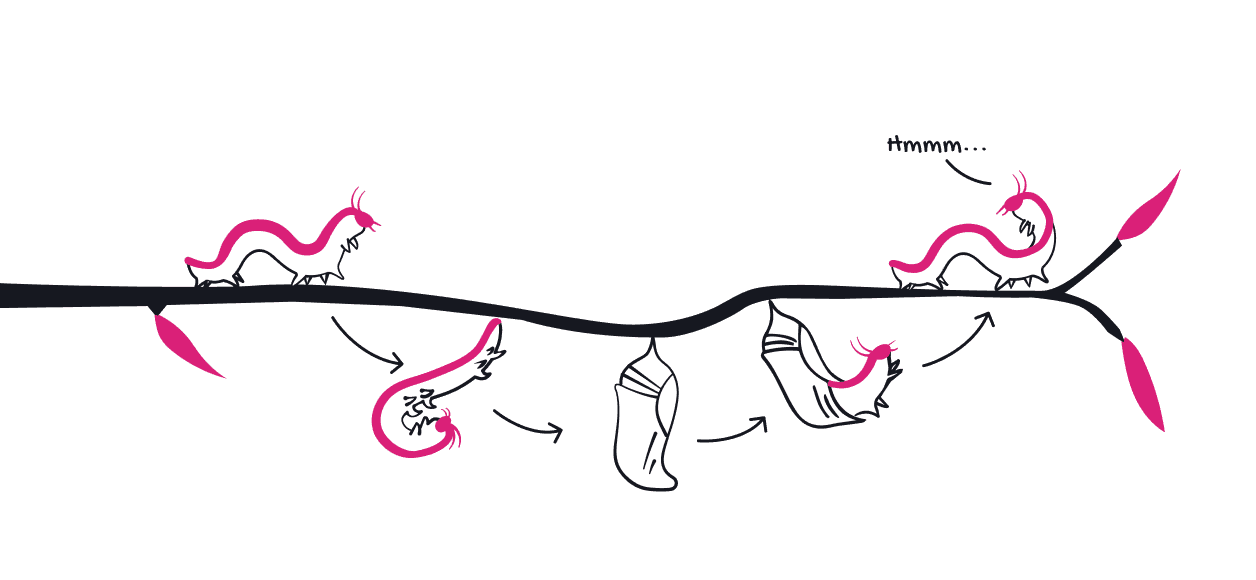
We called it the butterfly problem. Companies entered a multi-year cocoon hoping to emerge transformed. What often happened was that the technology moved on while they were inside. Customer expectations shifted while their existing platforms stagnated. The team that started the program was rarely the team that finished it.
The patterns were consistent:
- Goals were too ambitious. A single leap from current state to future state, planned without enough information about either.
- Timelines were too long. Three-to-five year programs in a digital ecosystem that reinvents itself every eighteen months.
- Programs were too big. Enormous teams, enormous budgets, enormous risk concentrated in a single bet.
- Business stalled while transformation happened. The "real work" got deprioritised in favour of the program.
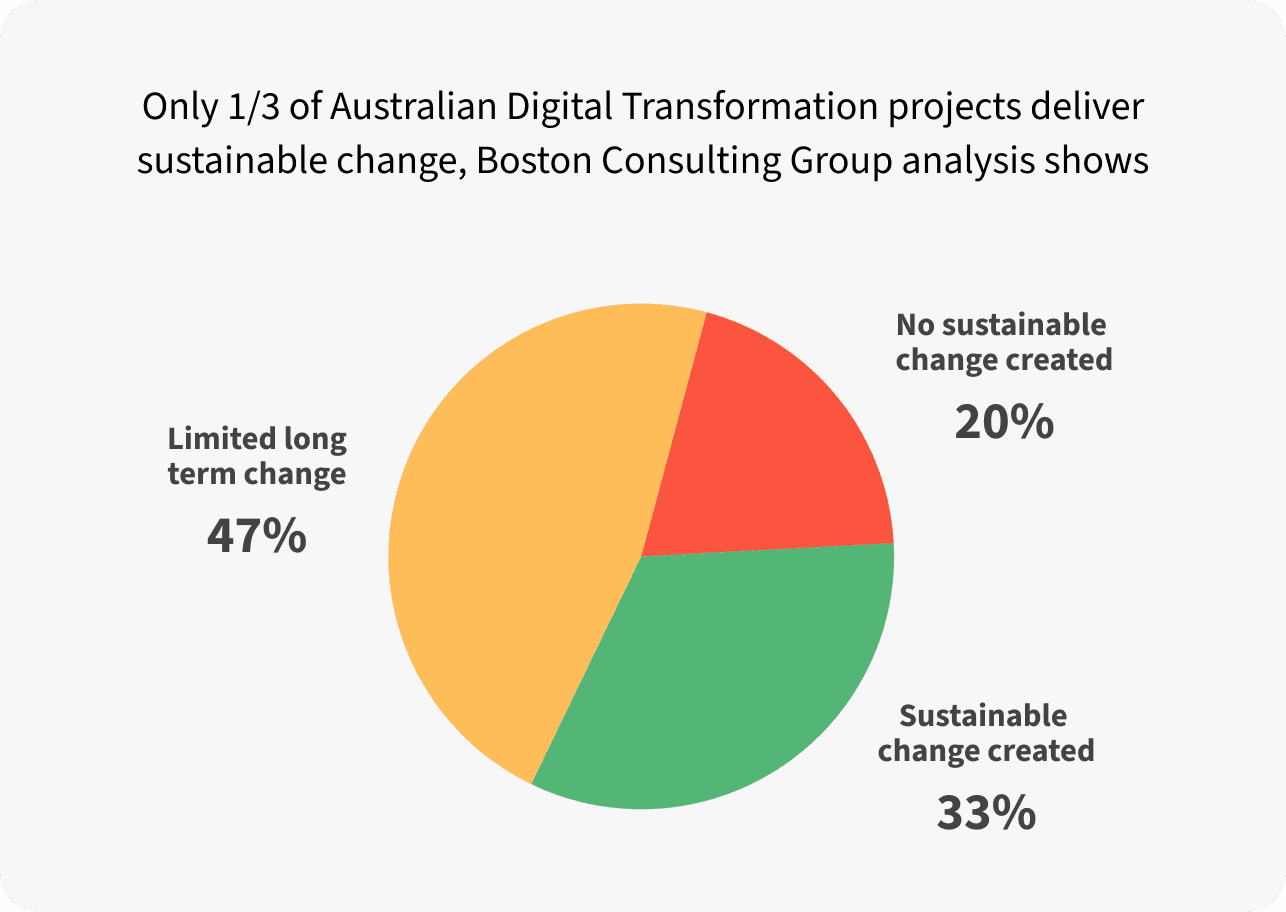
In 2021, BCG found that only one-third of Australian digital transformations succeeded. In 2024, Bain reported that 88% of business transformations fail to achieve their original ambitions. The headline failure rate has barely moved in over a decade.
The lessons that still apply
We've spent years arguing for a different approach to digital change. The three principles we've written about apply just as cleanly to AI.
- Evolution over transformation:
A multi-year AI transformation program risks being obsolete before it finishes. The leading model today won't be leading in twelve months. The vendor of choice today may not be at the end of the contract. Build the capability to evolve, not the program that locks you in place. - Products over projects.
Treat AI capabilities as evolving products, not projects with an end date. The companies extracting value from AI are running short cycles, measuring outcomes, and compounding learning. They're not running three-year roadmaps. - Start small, with real pain points.
Josh Rowe captured this neatly in a recent piece: the right question isn't "where can we deploy agents", it's "where is work stuck because humans are still carrying context between systems, teams, and approvals". Find one workflow where senior people are spending too much time chasing context, preparing summaries, or coordinating across systems. Solve that. Move on to the next.
This isn't a slower path. It's a faster one. It just doesn't look like a transformation program.
What digital leaders should be thinking about
For CIOs, CTOs, and CEOs being asked about an AI strategy, these are the questions that tend to matter most:
- Can your foundations support AI?
Most AI value depends on agents being able to read across systems and act on consistent data. If platforms are closed monoliths with limited APIs, no AI strategy will rescue them. AI exposes weak architecture faster than digital did. - Where is work actually stuck?
Identify the workflows where preparation, chasing, summarising, and coordinating are consuming senior time. These are good AI starting points. Probably not the ones in the vendor demo. - What's the boundary?
What can an agent read? What can it draft? Where must it stop? Who owns the outcome? Bounded delegation is more valuable than sweeping autonomy, and a lot safer. - How will you measure it?
Cycle time, rework, decision quality, cost to serve. Real outcomes. Not "we deployed an agent". - Are you architected to swap?
Whatever model, vendor, or platform you choose today, you'll likely replace within twenty-four months. The architecture should let you.

Where we come in
This is where Inlight tends to be useful. We help clients identify the work that's actually stuck, build the composable foundations that make AI integration practical, and create the bespoke interfaces and workflows that sit on top of existing platforms. Then we keep evolving, treating digital and AI capabilities as products, not projects.
Most of the AI work we're doing doesn't look like transformation. It looks like solving one well-scoped problem, learning from it, and using the foundations to solve the next one faster.
The companies that will get this right:
The companies that get the most out of AI won't necessarily be the ones running the biggest AI transformation programs. They'll often be the ones who never had one. They'll have identified what was stuck. They'll have built the foundations. And they'll have kept evolving. The technology will keep changing. The lessons probably won't.
If you're navigating this and want to talk through where to start, please reach out.