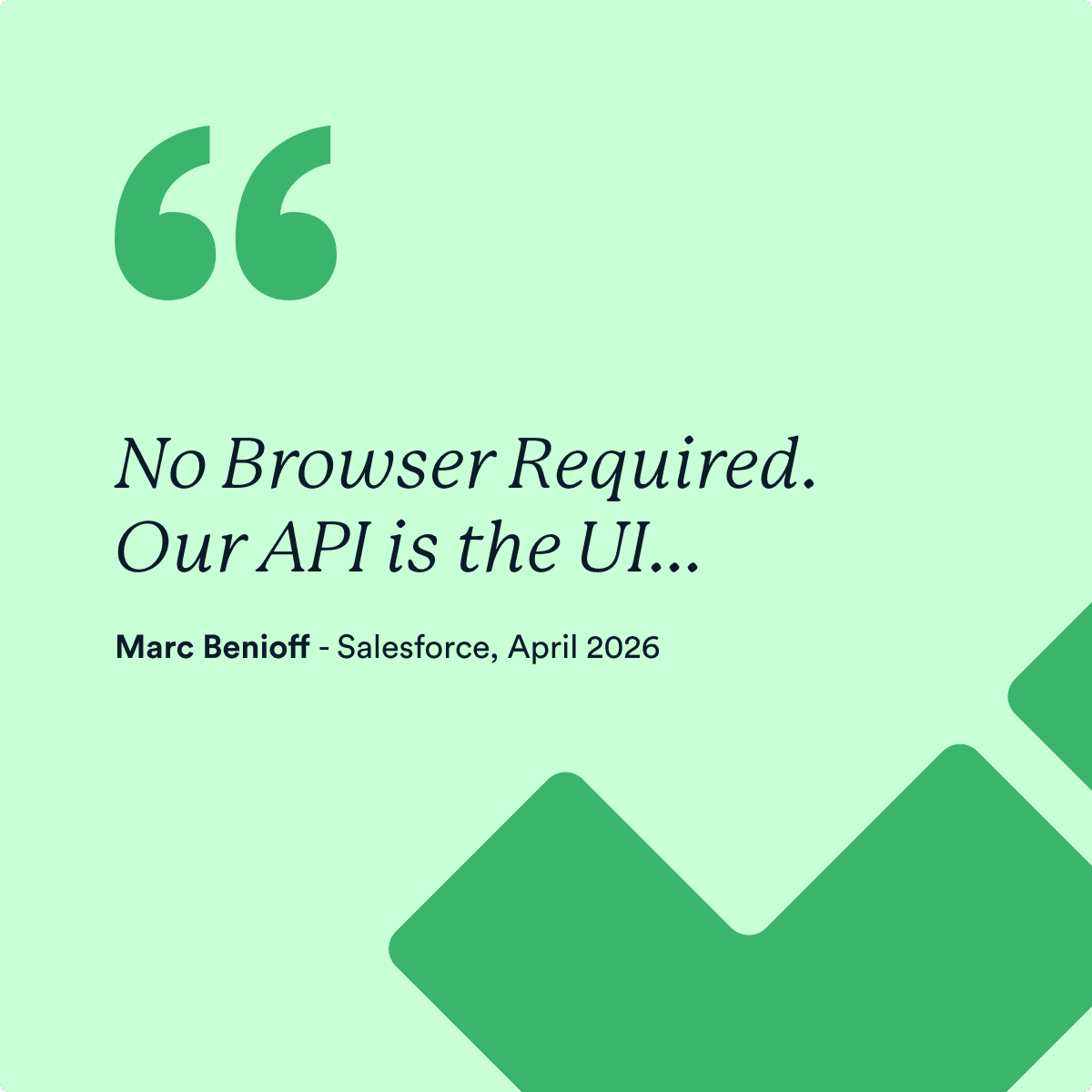
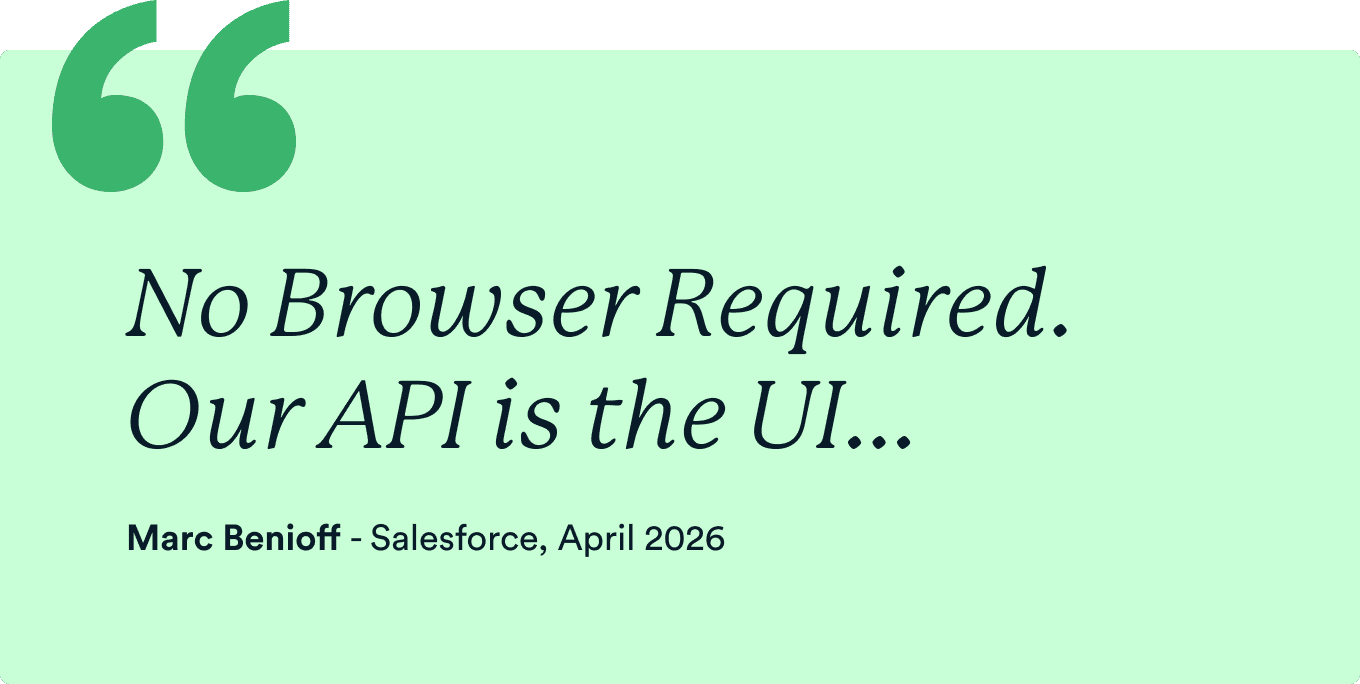
In April, Salesforce announced Headless 360 at TrailblazerDX 2026, calling it the most ambitious architectural transformation in its 27-year history. The tagline: "no browser required." A platform that, for most of its 27 years, has been experienced primarily through its own interface is now rearchitecting itself around APIs, Model Context Protocol (MCP) tools, and agent-first access.
This is notable, not because the idea is new, but because it demonstrates commitment from one of the largest platforms in enterprise SaaS, validating the approach that API-first vendors, the MACH Alliance, and the composable community have been advocating for years.
And Salesforce isn't alone. Headless is already entrenched across CMS and commerce platforms, and is emerging in both CRM and ERP applications. Over the next 12 to 18 months, I anticipate that every major SaaS category will follow suit. The more interesting question for digital leaders isn't the headless shift itself; it's whether your foundations, your data, your architecture, your integration patterns, are ready to take advantage of it.

What "headless SaaS" actually means
The short version: the vendor provides the foundations (data models, business logic, workflows, security, compliance, scale, reliability) exposed through well-documented APIs. You own the experience layer on top. No forced UI, no vendor templates, no workflow constraints baked into how the system has to be used.
You get the benefit of someone else's decade of investment in the parts that are genuinely hard (and not where you'd want to differentiate anyway), while keeping full control of the parts that shape your brand, your customer experience, and your competitive edge.

Why this is happening now
For those of us who've been building this way for a while, the current shift feels less like a revolution and more like consensus with the rest of the industry getting on board.
API-first, modular, headless design has been the quiet consensus among well-architected SaaS platforms for years. Stripe, Auth0, Sanity, Algolia, Braze, Contentful. These platforms didn't go headless. They started that way. They were built around the assumption that they'd be one part of a broader ecosystem, not the centre of a customer's entire digital estate.
The MACH Alliance has been formalising these principles for over five years now: Microservices, API-first, Cloud-native, Headless. A clear framework for how modern software should be built, grounded in decades of architectural lessons from the web's evolution.
What's changed is that the forces making this architecture necessary have reached a tipping point:
- AI agents are becoming primary users of enterprise software, and they don't need dashboards, they need APIs.
- AI-assisted development is making custom experience layers dramatically cheaper to build.
- Customer expectations are moving faster than any single vendor's roadmap can keep pace with.
- The switching costs that used to protect monolithic platforms are eroding.
The result is that the architectural approach the composable community has been advocating for years is now becoming the baseline expectation across every category. Good news for anyone who's been paying attention.

Proven foundations, bespoke experiences
This is the real opportunity, and it's where the composable argument has always been strongest.
When you build on headless SaaS, you inherit the benefit of decades of work in the areas where it's genuinely hard to compete: security, compliance, scale, reliability, data modelling, integrations, uptime. Reinventing any of that is rarely a good use of investment.
What you keep is everything that differentiates you. The interface. The workflows. The brand expression. The moments of delight or friction that define how your customers actually experience your product. Those sit in your code, your design system, your IP, not your vendor's templates.
And critically, the time and money your team would have spent reinventing those foundations gets redirected to the things that actually differentiate you. More of your investment goes into the parts that customers feel, less into the parts they shouldn't have to think about.
Foundations matter more than ever
Whether you're running a mature platform like Salesforce or building something bespoke, it's still crucial to get the foundations underneath right. A data architecture that reflects how your business actually operates. Business logic that lives where it belongs, not scattered across the UI layer. API and integration patterns that treat every consumer, human or machine, as a first-class citizen. An identity and access model built for agents, not just users. The parts that are unglamorous, hard to change later, and unforgiving when they're wrong.
“An AI-enabled future isn't something you bolt on, it's something your architecture either enables or quietly prevents.
AI is part of why this matters more now, not less. For the first time, your digital systems have a new kind of consumer alongside humans. AI agents can now pull data, trigger actions, and make decisions on behalf of customers and staff. Unlike human users, agents can't intuit missing context or route around inconsistent data. Gaps that humans can navigate almost subconsciously become reliability and accuracy problems the moment an agent is in the loop. What used to be a UX problem is now a correctness problem.
At the same time, the experience layer is getting faster to build. AI-assisted development is compressing the time and cost of bespoke UI dramatically. Design systems, front-end frameworks, and modern tooling mean differentiated, customer-specific interfaces are no longer the constraint they used to be.
What that leaves is the foundations. Get them right and everything above them becomes possible. Get them wrong and everything above them becomes fragile, regardless of how polished the front-end looks or how sophisticated the AI integration feels.
A new way to interface with your systems
When people hear "bring your own frontend" the assumption usually means building a bespoke app or interface, but it doesn't have to.
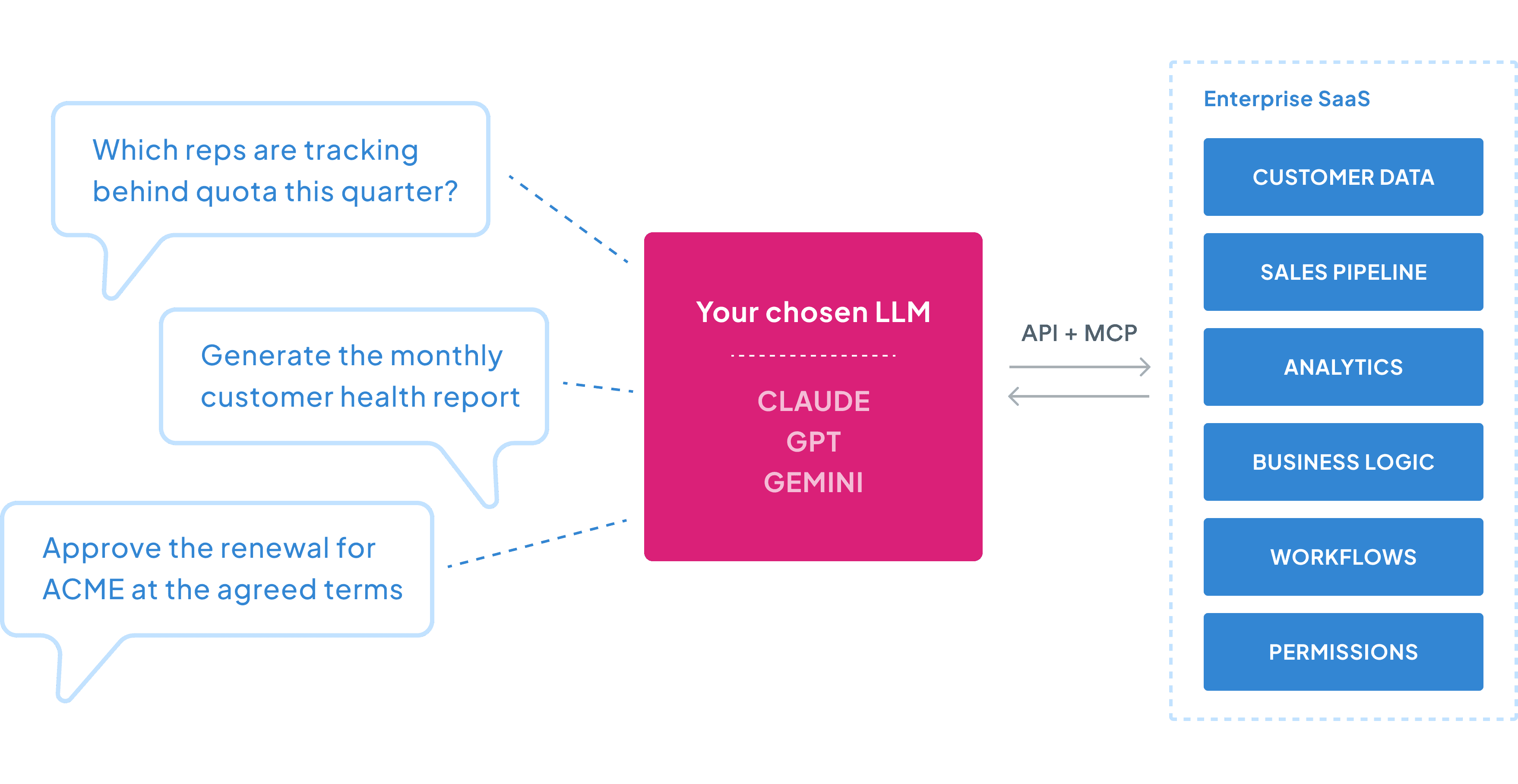
Once a platform is fully exposed through APIs and MCP tools, organisations can connect their chosen LLM directly to it. Claude, GPT, Gemini, whatever makes sense for the business. That unlocks a genuinely new kind of interface: a conversational layer over your data and workflows. Ask a question, get an answer. Request a report, have it generated. Trigger a workflow, in plain language.
For a meaningful slice of internal use cases, that's going to be a better interface than any dashboard or form. Not for everything, bespoke UI still wins for customer-facing experiences, high-frequency tasks, and anywhere speed or precision matters. But the ability to add a conversational layer over the top of your platforms, without rebuilding them, is one of the most practical benefits of this architectural shift.
What this means for digital leaders
The implications for agencies and consultancies are worth exploring too.
A lot of the work that defined the last generation of digital agencies (namely implementing and configuring monolithic platforms), is commoditising rapidly. AI-assisted development and the rise of agent-driven tooling are compressing the time and cost of that kind of work significantly.
What becomes more valuable is the other end of the stack:
- Strategy and architecture, helping clients make smart, evidence-based decisions about which parts of their ecosystem to replace, extend, or integrate.
- Research & design, where customer experience is actually shaped.
- Integration, orchestration, and data architecture become first-class disciplines in a composable world rather than afterthoughts.
This shift is part of why Inlight recently joined the MACH Alliance. It's not a badge for us, it's a statement about how we think great digital products should be built, and a commitment to working with clients who want their architecture to be an enabler rather than a constraint.
Where to start
Adopting a headless architecture introduces integration complexity that needs to be managed deliberately. API versioning, data consistency across services, governance, and orchestration all become first-class concerns. Without discipline, a composable stack can become a tangle of brittle integrations.
Not every part of your stack needs to be headless, and not every transition needs to happen at once. As a starting point, identify the systems that are constraining your customer experience the most, or those that are limiting your ability to move quickly. Break those down. Validate the approach and evolve from there.
Switching to a composable architecture should be the last transformation you ever need, but it doesn't necessarily need to be a big bang to get there.
The shift is real, and it's accelerating. When a platform the size of Salesforce declares that API-first and agent-ready is its new default, the rest of the market tends to pay attention and follow quickly.
What's encouraging is that the principles guiding this shift aren't new, and they aren't theoretical. The MACH community, the best-in-class SaaS ecosystem, and the agencies that have been building this way for years all offer a mature, proven path forward.
If you're looking at your digital stack and wondering whether your platforms are genuinely enabling you, or quietly constraining you, I'd love to chat.
Reach out and connect